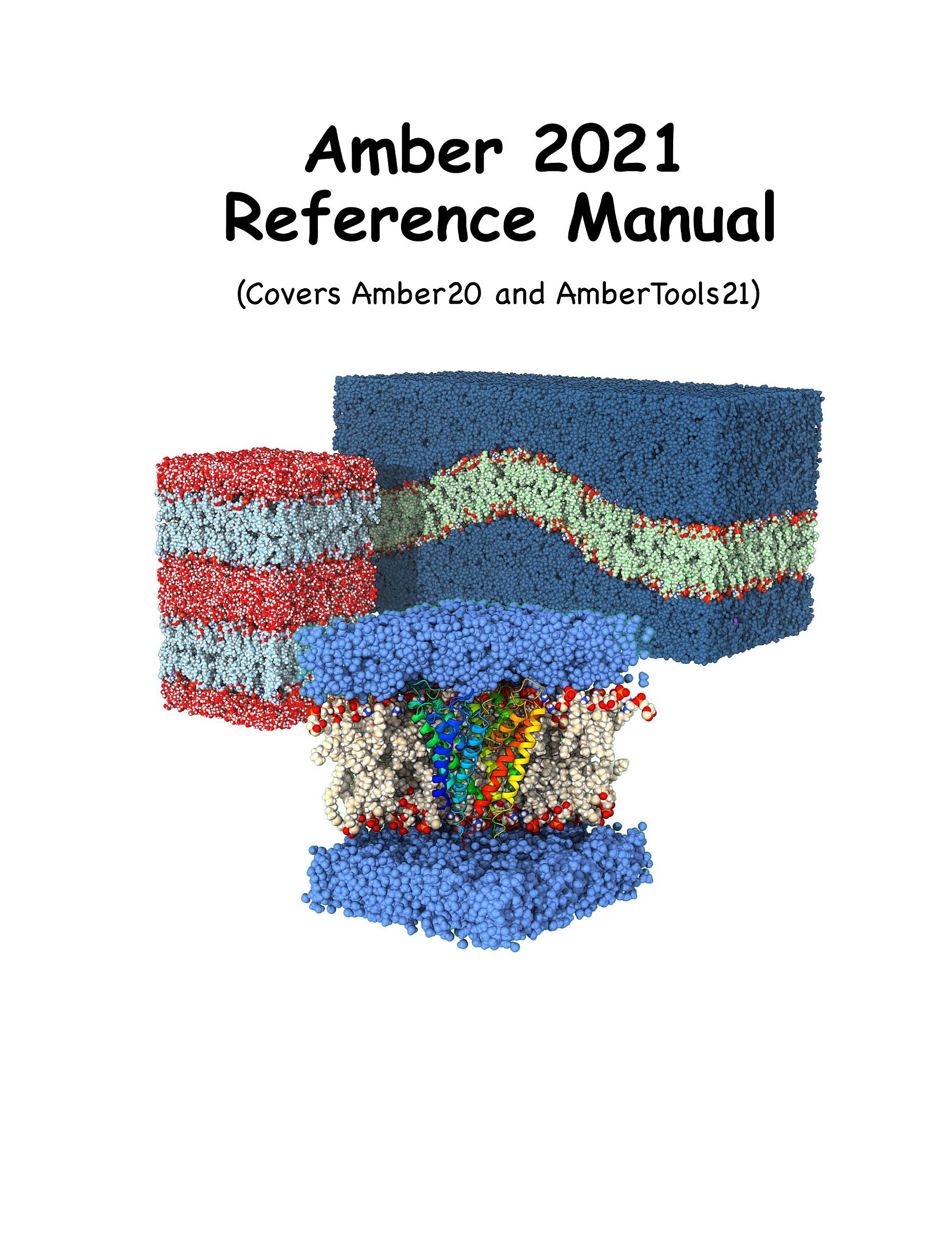
Amber 2021
by David A. Case, H. Metin Aktulga, Kellon Belfon, Ido Ben-Shalom, Scott R. Brozell, David S. Cerutti, Thomas E. Cheatham III, Vinícius Wilian D. Cruzeiro, Tom A. Darden, Robert E. Duke, George Giambasu, Michael K. Gilson, Holger Gohlke, Andreas W. Goetz, Robert Harris, Saeed Izadi, Sergei A. Izmailov, Chi Jin, Koushik Kasavajhala, Mehmet C. Kaymak, Edward King, Andriy Kovalenko, Tom Kurtzman, Taisung Lee, Scott LeGrand, Pengfei Li, Charles Lin, Jian Liu, Tyler Luchko, Ray Luo, Matias Machado, Viet Man, Madushanka Manathunga, Kenneth M. Merz, Yinglong Miao, Oleg Mikhailovskii, Gérald Monard, Hai Nguyen, Kurt A. O’Hearn, Alexey Onufriev, Feng Pan, Sergio Pantano, Ruxi Qi, Ali Rahnamoun, Daniel R. Roe, Adrian Roitberg, Celeste Sagui, Stephan Schott-Verdugo, Jana Shen, Carlos L. Simmerling, Nikolai R. Skrynnikov, Jamie Smith, Jason Swails, Ross C. Walker, Junmei Wang, Haixin Wei, Romain M. Wolf, Xiongwu Wu, Yi Xue, Darrin M. York, Shiji Zhao, Peter A. Kollman, Amber Smith
About this book
Amber is the collective name for a suite of programs that allow users to carry out molecular dynamics simulations, particularly on biomolecules. None of the individual programs carries this name, but the various parts work reasonably well together, and provide a powerful framework for many common calculations. The term Amber is also used to refer to the empirical force fields that are implemented here. It should be recognized, however, that the code and force field are separate: several other computer packages have implemented the Amber force fields, and other force fields can be implemented with the Amber programs. Further, the force fields are in the public domain, whereas the codes are distributed under a license agreement. The Amber software suite is divided into two parts: AmberTools21, a collection of freely available programs mostly under the GPL license, and Amber20, which is centered around the pmemd simulation program, and which continues to be licensed as before, under a more restrictive license. Amber20 represents a significant change from the most recent previous version, Amber18. (We have moved to numbering Amber releases by the last two digits of the calendar year, so there are no odd-numbered versions.) Please see https://ambermd.org for an overview of the most important changes. AmberTools is a set of programs for biomolecular simulation and analysis. They are designed to work well with each other, and with the “regular” Amber suite of programs. You can perform many simulation tasks with AmberTools, and you can do more extensive simulations with the combination of AmberTools and Amber itself. Most components of AmberTools are released under the GNU General Public License (GPL). A few components are in the public domain or have other open-source licenses. See the README file for more information.
Similar books
Rummaging the shelves…
Reviews
Loading reviews…