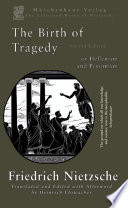
The Birth of Tragedy, or Hellenism and Pessimism
A New Reader's Edition
Publisher, ISBN & more
- Publisher
- Marchen Press
- ISBN
- 9783689382308
About this book
Nietzsche wrote "The Birth of Tragedy from the Spirit of Music", one of his most influential works, during his intensive friendship with Richard Wagner in Basel, after meeting him in Leipzig in 1868. In 1869, at the young age of 24, Nietzsche accepted a professorship in philology, which facilitated his acquaintance with the composer, who lived in Tribschen. In 1871, he began work on his book, originally titled "Origin and Goal of Tragedy". When it was published in Leipzig in January 1872, Die Geburt der Tragödie aus dem Geist der Musik (The Birth of Tragedy from the Spirit of Music) was warmly received by Wagner. The scholarly community, however, remained largely silent, except for the classical philologist Ulrich von Wilamowitz-Moellendorff (1848-1931), Nietzsche's former colleague, who criticized the book in his "Zukunftsphilologie. Wilamowitz's critique shaped the direction of classical studies well into the 1940s, leaving Nietzsche largely marginalized. Nietzsche was 27 at the time of publication, and largely summarizes all of his major ideas up until that point. This translation is from the second edition Nietzsche published in 1886, which was re-titled "The birth of tragedy or Hellenism and Pessimism", sometimes translated "Greekness and Pessimism". This second edition contains the famous essay "Attempt at Self-Criticism". Here he introduces to the public the concepts of the Apollonian and Dionysian forces, representing the rational, orderly aspects of human existence and the chaotic, instinctual elements, respectively. Nietzsche argues that the interplay between these forces is central to the creation of meaningful art, particularly in the genre of tragedy, which he sees as a profound expression of the human condition. This seminal work posits that the beauty of the Greek tragedy arose from the tension and interplay between these Psychological opposing forces, suggesting that tragedy embodies the fundamental contradictions of human realities. Freudian theories of the subconscious were deeply influenced by Nietzsche and Schopenhauer's belief in these meta-psychological forces, which Nietzsche calls later the "inner gods". This Critical Reader's Edition offers a modern translation of the original manuscript, designed to help the armchair philosopher engage deeply with Nietzsche's works. The translation features clean, contemporary language with simplified sentence structures and diction, making Nietzsche's complex ideas more accessible. In addition to the main text, this edition includes extensive supplementary material that enhances the manuscript with autobiographical, historical, and linguistic context. It contains an afterword by the translator examining the history, impact, and intellectual legacy of Nietzsche in relation to this work, an index of philosophical concepts with emphasis on Existentialism and Phenomenology, a complete chronological list of Nietzsche's published writings, and a detailed timeline of his life, highlighting the personal relationships that significantly shaped his philosophy.
Similar books
Rummaging the shelves…
Reviews
Loading reviews…